
CG Conn

C.G. CONN, ESTABLISHED IN ECKHART, INDIANA, IS THE FATHER OF SAXOPHONE MANUFACTURING IN THE UNITED STATES. DISCOVER THE LEGACY.
Conn, the first of the instrument manufacturing businesses to establish themselves in Eckhart, IN, all started with a simple innovation to the mouthpiece to make it conform better to the mouth. After Conn, a lifelong cornet player who had made the invention for himself, showed his friends his idea, he saw that there was tremendous demand for his invention. In 1873 Conn converted a discarded sewing machine frame into a simple lathe and started to turn out his rubber-rimmed mouthpieces. Soon he was in full production.

America's First Saxophones
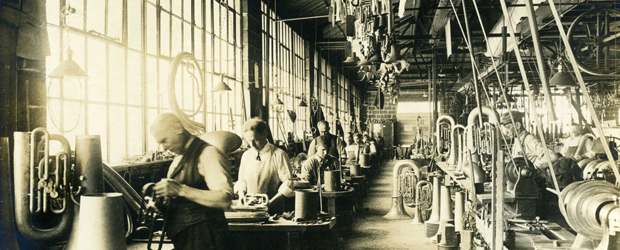
Conn's rubber-rimmed mouthpiece was patented in 1875. That same year he worked with Eugune Dupont to design Conn's first cornet called the Four-In-One. By 1877 Conn's business outgrew the back of the grocery store, and he purchased an idle factory building and began to make band instruments of all kinds. Conn started production of the first American-made saxophone in 1888, after being shown an Adolphe Sax saxophone by then-employee and later competitor Ferdinand Augustus “Gus” Buescher and agreeing to produce a copy of it. With some advice from Lefebre, Conn settled on production models of saxophones and regular production began around 1892. By 1905 Conn had the world's largest musical instrument factory producing a full line of wind instruments, strings, percussion, a portable organ, and gramophone bells.
In 1915 all of Colonel Conn's holdings were bought by a group of investors led by Carl D. Greenleaf of Wauseon, OH. Greenleaf incorporated his new holdings under the name C. G. Conn, Limited, and retained the Conn trademark on his musical instruments. Noting the decline of the small-town brass band as well as the large touring band, Greenleaf developed a plan to promote band programs in schools and colleges.
By 1920 Conn was producing a complete line of saxophones. Around this time Conn introduced rolled tone hole rims, a feature that improved the seal of the pads and extended pad life. These tone holes were a feature of Conn saxophones through 1947 and would be mimicked by competitors. Notably, this was the time of Conn’s "New Wonder" saxophone.
After the death of Carl Greenleaf, Conn lost its hold on the leadership of the industry and gradually declined. In an attempt to save money, the factories were moved to different locations around the country and to Mexico. But in 1986 Conn Ltd sold to United Musical Instrument, which would eventually be purchased itself by Steinway Musical Instruments. The Selmer subsidiary of Steinway was merged with Conn into Conn-Selmer after the acquisition.
History of C.G. Conn
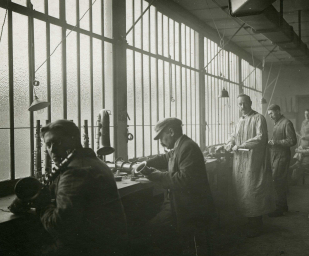
C.G. Conn has a rich and well-known history. Learn more about both the innovators and the innovations in the full history.
Coming Soon