
King

King Musical Instruments was started in 1893 as the H.N. White Co. by Henderson White when he purchased the music store of O. F. Berden, to whom he was apprenticed.
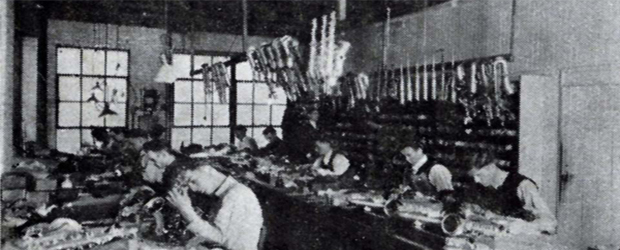
King Musical Instruments was started in 1893 as the H.N. White Co. by Henderson White when he purchased the music store of O. F. Berden, to whom he was apprenticed. White himself was a talented music engraver and instrument repairman. The branding with the name King comes from an early collaboration with trombonist Thomas King of the nearby Lyceum Theater. White worked on perfecting the trombone while King would come to the shop, playtest, and review the instrument. Once it was ready, the trombone would be branded with the name King and the success of the instrument would be the foundation of the manufacturing company. A craftsman at heart, White would work alongside his employees in the creating of instruments for years even after success would make it possible for him to work solely in management.

“Metal and Brains and Heart”
In the early 1900s White was looking to expand beyond the trombone. Their foray into the saxophone began in 1908. King started as a US distributor for Evette & Schaeffer, then V. Kohlert, and finally Martin “American Perfection”. During this time, they were preparing facilities to build King brand saxophones. In 1916 Mr. White began producing his own saxophones, which were advertised just as “King” saxophones then later would be known as the H.N. White model saxophones. The initial line consisted of soprano, Eb alto, C melody, Bb tenor, and baritone saxophones.
Although the business struggled some with manufacturing instruments for the public with the entry of the US into World War I, military contracts for instruments were able to keep the factories running. After showing some of the first saxophones to the inspector at the Quartermaster Depot, King began providing saxophones for the military. From 1917 to 1918 the HN White Company was the sole provider of saxophones for the US military. According to their 1918 advertising, fulfilling these government contracts took all their saxophone production capability for the first two years, so there are no ads for the “King” brand saxophones during that time. It was at this time that they offered the “American Perfection” stencil saxophones in their catalogs.
The famous King Saxello was introduced in 1924-25 and had a half-turned bell with curved top. Other manufacturers have made tipped bell saxophones, but the Saxello is distinguished largely by its 90-degree angle. Patent 1605101 for the Saxello was granted on November 2, 1926. The goal of the Saxello was to achieve the clarity of tone of the straight soprano saxophone while making the soprano comfortable for long hours of playing. Soon after the company would come out with the Voll-True series of saxophones, which were advertised alongside the Saxello. The Saxello was quite acclaimed during its time, but development on it stopped due to the Second World War.
After the war, Mrs. White restarted production of only the most popular and profitable instruments. Thanks to dedicating some craftsmen to research and development at the end of the war, in 1945 King was able to introduce a new line of saxophones called the Super 20. The company marketed the Super 20 as an entirely new saxophone built from the ground up. In reality, the Super 20 was a refinement of the Zephyr Special, which was in production from 1937, only a short time before the war. The Super 20 was an immediate sales success and gained renown as saxophone greats like Julian "Cannonball" Adderley, and Charlie "The Bird" Parker played the Super 20. The silver bell was later added and advertised as improving the tone, especially played at fortissimo. In 1950 these "Silver Tone" instruments were renamed "Silversonic."
The company's name was changed to King Instruments when Nate Dolin became owner in 1965. To meet increased demands, the company moved to a location at 33999 Curtis Ave. in Eastlake. In 1985 it was purchased by Bernhard Muskantor and became the manufacturing division of United Musical of Elkhart, IN, as it remained in 1995. The King brand is now owned by Conn-Selmer, who manufacture King trumpets, trombones, tubas, sousaphones, and marching-focused brass instruments.
History of Buescher
One of the big names that made Elkhart famous, Buescher made massive innovations in saxophone manufacturing during the jazz era. Get the complete history.
Coming Soon