
Grafton

IN REACTION TO THE SCARCITIES OF METAL DURING WORLD WAR II, HECTOR SOMMARUGA DEVELOPED THE PLASTIC GRAFTON SAXOPHONE.
During World War II the musical instrument industry was brought to a halt by limitations on the metals used in manufacturing – such as copper and zinc (used to make brass), iron, and steel. These materials as well as some instrument manufacturing factories were repurposed to meet wartime needs. Hector (born Ettore) Sommaruga found an innovative and direct solution to the difficulties producing instruments. Aware of the emergence of synthetic plastic as a manufacturing medium, Hector saw that molded plastic would be cheap, a long-term solution against future scarcities in the marketplace of metals and adaptable to mass production.
"A Tone Poem in Ivory and Gold"
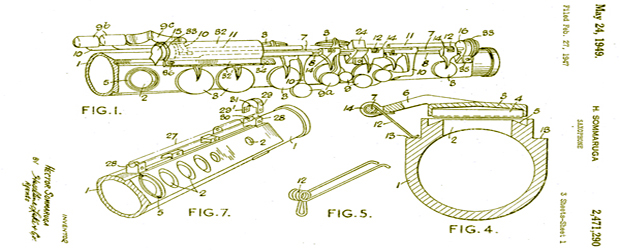
As the war was ending, Sommaruga applied for patents for his plastic saxophones. He applied for his first patent in 1945 and his patents were all accepted in 1948. A practical manufacturing scheme was evolved to produce the following individual parts prior to assembly: (i) the body, (ii) the bell in two parts, (iii) two key guards, (iv) a brass mouthpiece (it proved too difficult to attach a conventional mouthpiece to a plastic mouthpipe), (v) some of the pillars, with all supports incorporated in the main mold, (vi) a redesigned, simplified key mechanism working as efficiently as with a brass saxophone but with a new type of spring to replace needles. A hand-made, unplayable prototype was ready for the Britain Can Make It exhibition of 1946. The engineering firm, De La Rue, did the molding using powder produced by Imperial Chemical Industries. It was the largest piece of injection molding attempted up to that time. Experiments were carried out to produce a tenor saxophone, but this proved too much for the molding processes of the time, so it was only possible to produce the Grafton Saxophone in alto and smaller sizes.
The instrument initially was released to much acclaim. On the original advertising broadsheets, the photographs of no less than fifteen leading British saxophonists appear. This included John Dankworth, who had collaborated on creating the instrument, as well as legendary Freddie Gardner. The buzz around the instrument even reached the standard press as the idea of the improvements with plastics reaching to traditionally metal instrument production captured the public imagination.
However, there was to be substantial pushback, especially in the music community, against the instrument. Notably, the Grafton company was relying on schools purchasing a substantial number of instruments - especially in the United States of America. However, American traders conspired to boycott the new plastic instrument as its sale could negatively impact the sales of traditional instruments. Rumors like the story of Ornette Coleman literally having his Grafton saxophone fall to pieces in his hands on the stage began to spread and put off potential buyers, despite the reality that the saxophone was genuinely robust.
The true problem of the saxophone was that although the body of the instrument was quite tough and very cheap to produce, if it was dropped it might crack and repairs presented a serious problem. Because of the unconventional body and mechanism with its wire-wound springs, repairers refused to tackle them or would do so only under protest. The Dallas Company had a repair service where, if an overhaul were required, the company took the instrument into its workshop and immediately handed out in exchange either a new or fully reconditioned one. Other technical disadvantages were that the side and rear key guards were plastic attachments and were easily snapped off. Further, there were too many 'adjusting screws' — fine in a comfortable environment with a well-cared-for instrument but an infernal nuisance to a player on the road where the instrument had to take occasional knocks and rough treatment. Some of these design flaws could perhaps have been overcome if more money had been spent on continuously improving the quality. However, the goal of Sommaruga was to bring a good saxophone into the price range of anyone who wished to play. Although the timing seemed excellent, perhaps Grafton arrived on the scene about twenty years too early.
Although Grafton has closed its doors and brass has continued to be the standard for saxophone as well as other brass instruments, plastics have not disappeared from the music scene. New materials and techniques are constantly being developed and as of the early 2000’s it has been primarily toward the woodwind section that they were directed. Recorders, piccolos, oboes, clarinets, and bassoons are freely available in the new plastics and, for the sake of lightness they have been successfully applied to the bells of larger brass instruments. On well-made plastic instruments, some musicians will say that there is no decrease in sound quality. In fact, many will testify to an improved brightness and more fluent emission of sound due to the high polish attainable on the bore. The future of plastics in instrumentation is still up in the air, but they are not gone for good.
History of Grafton
An inventor with the needs of the time in mind, Grafton built plastic saxophones with a beautiful sound. Get the complete history.
Coming Soon